Testing whether performance claims drive adoption
Context
Many Ads Manager products used vague performance claims in product descriptions to get advertisers to adopt them: "improve campaign performance," "we predict will perform best," "when we think it may perform better." None of these value props had any data behind them. Teams kept using them because they assumed the claims drove adoption.
I designed and led a content experiment to test that assumption. It was framed around one question: do vague performance claims add any value? If removing them dropped adoption, they were driving decisions. If not, we could replace them with more personalized value props.
Problem
For advertisers
- Vague claims didn't help advertisers choose. Every product promised "better performance," so the phrase became noise advertisers learned to ignore. Without a specific benefit, advertisers couldn't tell which product fit their needs.
For the business
- No shared content standard. There was no rule for when a performance claim was allowed. Every team wrote its own value props, so vague performance claims spread.
- Real proof got diluted. When every product promised better performance, the products with real proof, like data-backed recommendations and Advantage+ products, stood out less.
Hypothesis
Vague performance claims don't drive advertiser decisions. Removing them won't hurt adoption or revenue.
Key decisions
1. Test the assumption before rewriting anything
- The performance claims looked weak to me, but most product teams believed removing them would hurt adoption. Rewriting on instinct would have turned into a debate about opinions, rather than a clear decision based on evidence.
- I wanted evidence that removing them did no harm. Content designers across the Ads org could then use it to write stronger value props.
2. Design a test people can trust
- I focused the test on 4 products where advertisers interact with the product, like checkboxes and toggles, so we'd get real usage data. I limited the test to sales and lead campaigns, where performance matters most.
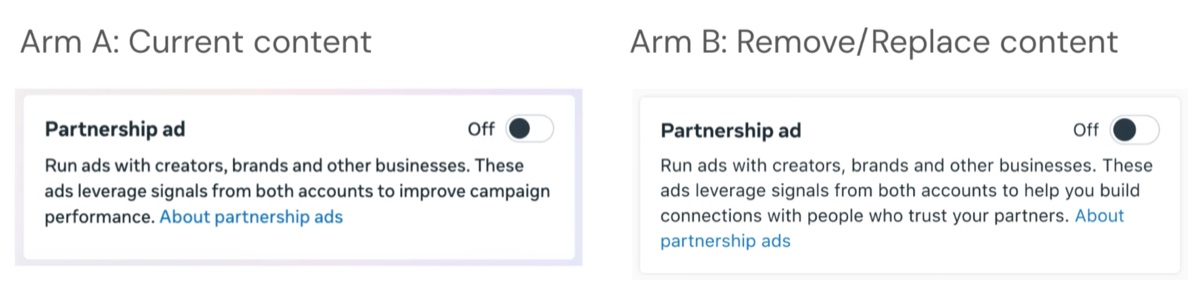
- For each product, I either removed the claim or replaced it with a specific benefit, depending on what made most sense for that product:
Product Before After Partnership ads "...to improve campaign performance" "...to help you build connections with people who trust your partners" Text "...we'll show the one we predict will perform best" "...we'll personalize variations to different audiences" Image crop "...cropped it to fill the placement when we think it may perform better" "...cropped it to fill each placement better" Advanced preview "We'll show variations of your ad we predict will resonate with different people to improve performance" "We'll show variations of your ad to different audiences to prevent creative fatigue."
3. Turn the result into a content standard
After the test showed no drop in adoption or revenue, I wrote a content standard for the Ads org: no performance claims can be used as value props in Ads Manager without data. It includes:
a) Five principles
- Lead with the advertiser's outcome.
- Be specific. If a value prop still makes sense on another product, it's too generic.
- Save performance claims for products with proof.
- Let a clear description of what the feature does be the value prop.
- Match the message to the decision the advertiser is making:
Decision What the advertiser needs to know How to write it Turning a feature on Why should I turn this on? Lead with the benefit Choosing between options Which one fits my goal? Lead with the difference Reviewing a preview Is this what I expected? Say what changed and why A feature that's on by default What is this doing to my ad? Just explain what it does
b) A toolkit of value prop themes
It covers themes like personalization and creative variety, with guidance on when to use each. It helps content designers use the type of value prop that best matches their product's core value, and helps advertisers make optimal decisions.
Outcomes
- Across hundreds of thousands of ad accounts, removing vague claims caused no measurable drop in adoption or revenue for any of the 4 products.
- I co-run reviews with another content designer for teams applying the new standard.